Friday, 23 March 2012

First Draft of Script

Characters:
Old man – deliberately kept with no name throughout
Young woman/teenager – Jane

Plan – two scenes shooting identical ideas but contrasting between the two

Start of the opening sequence:
Production Company Logo shows then fades to a black screen
Opening sequence starts:
The old man is sitting at the table with a number of candles lit around him - the camera is concentrating on the arrangement of this table, when the man’s hand is exposed to light the final candle.
There is complete silence in the background, with the exception of a clock which we frequently hear ticking.
The camera at this point is still centring on the hand.

Old man  “Perfect”
Picks up his knife and fork.
Old man  “I apologise, how rude of me to forget”
His hand pushes down a switch on a stereo which is positioned on the edge of the table.

Gentle and romantic music starts to play.
Credit appears on top of the scene; director 

The camera gradually moves up (over the shoulder shot) to the man until finally were in contact with his face.

Old man – “I thought your dad was going to stop calling”
There is no reply and the man takes a bite of his food.
Old man – “Its rude to ignore when I’ve gone to all this effort, would you like some wine?”
The man picks up the bottle of wine which is centred likewise on the table.
The camera follows his arm down the table and then a fade-in fade-out is used.

[The location has changed to demonstrate to the audience the definite reality of what is actually happening as an alternative to what the man is seeing in his head]

The camera is still focusing on his arm.
He finishes filling up the glass for the person which he is speaking to.

The music is still playing; however from this point onwards the man doesn’t say anything else.

The camera slowly rises and pans around the setting, until it ultimately reaches the person he is speaking to on the other side of the table. 
A girl which is tied to a chair with tape around her mouth struggling.

The rest of the credits are shown on top of the scene; actors
Narrative enigma is immediately created leaving the audience curious as to why she is tied up, but also why the man in his mind is consuming a pleasant meal with her.   

Character Description

Due to the fact our opening sequence is going to be quite puzzling, we will only have two characters featuring in it. One of these being a young girl, who gets kidnapped, tied up and held captive. The other being an old man who will actually be the one keeping the young girl. However, we will need to have a better and more detailed perceptive about these characters in order for the actors to play their role greater. Therefore a character description will illustrate in more detail, the background of both of the characters but also more about them as a person.

The Girl:
Name: Jane
Age: 17
Ethnicity: White
Hobbies and Interests: She is extremely focused on school, as she wants to succeed to go onto university. She has a part time job in a local restaurant, but on weekends and in her free time she likes to socialize with friends, by going to parties and the cinema etc.
Social Demographic: Working Class
Personality: She is a shy, timid girl in front of people she doesn’t know and additionally in situations she is not comfortable with. This changes when she is with her friends, as she knows how to have a laugh and comes out of her shell more. Jane is a pacifist and doesn’t like hurting anyone or being hurt herself, this leads her to be over-protective of the loved ones around her.
Her Role: She gets captured and held captive, but cannot remember what happened or the reason behind it. She is kept for roughly 2 weeks, until she meets another victim and together they plan their escape.

The Man:
Name: Intentionally his identity is kept quiet
Age: 45+
Ethnicity: White
Hobbies and Interests: Loves being in control and is not a socialite. He doesn’t have any friends, and lives by himself in a moderately large house. Frequently he enjoys a game of chess, and this becomes evident further into the story, he also enjoys reading, but X-rated books are more his thing. He is mentally ill and believes what he is doing to the young girls is tolerable and of the norm.
Social Demographic: Middle Class
Personality: He keeps himself to himself, but due to the fact he dresses in branded suits, we make an assumption that he has a well-paid job, if one?
His Role: He captures the young girl and keeps her in a hidden location. He excuses his behaviour by bringing dinner, and talking to her. He thinks he is being harmless, and doesn’t really understand the consequence of his actions although.

Thursday, 8 March 2012

Contingency Plan

During the making of this opening sequence, we need to consider and resolve any problems that are likely to come up, it is essential that we think in advance in order to make a back up plan which could still allow us to film successfully.

Cast dropping out/Unreliable actors/Bad actors:
I am playing one of the actors so it is very doubtful that a problem will occur, however if I fall sick for example, we will use another group members sister who has agreed, due to the fact there isn’t a large amount of acting required the part is straightforward. For the old man’s role we have two actors who are both keen to take on the part, this means we can film both and then make a decision on which we think is more appropriate. 

Crew being late/getting lost:
Before we film, we will meet up with each person, and as we are going to previously agree a time in which everyone is free this shouldn‘t be a problem. We will assure the actors of where it is, and all travel together. We have also allowed an hour at the end of the filming time, so if for whatever cause a problem does occur with timing, we can make it up with this hour.

Problems with location/Too noisy/Having too much background noise:
Through our decision to keep both locations simple, there is no need for us to get authorisation to be able to film there. The opening scene will be filmed in either mine, or my group members dining room, and the other in a forest or a deserted building which is open for the public. We have purposely chosen these settings as both are distant from a main road, therefore it is improbable the background noise will override the filming. 

Battery running out on camera:
We will make sure that the battery of the camera is fully charged before we leave to film. If the camera battery does run out when we are in the middle of our task, we will simply return to the location a day later with the camera charged, but also a spare battery to carry on without any more disturbances. 

Continuity problems:
Fortunately, continuity editing has never been a trouble which has occurred with my group. We all take notice of all detail regarding this, and with every person paying attention it is unlikely for this to occur in our opening sequence. We too decided, by taking pictures of the location and the actors, we can resemble them if we film another day to help us over-come a continuity problem.

Wednesday, 7 March 2012

Locations Reece

Locations for our opening sequence:

The first location is in a dining room, we have chosen to use this location as we want the sequence to be as real to life as possible. This will be the first scene, and the actual introductory of the sequence, and due to the fact it is a standard dining room, it will be used as the man’s point of view, and what he considers is happening. We will pull the table away from the wall and decorate it appropriately (with rose petals, candles etc.) we will also move anything in the background that we do not want to feature in the scene; this is to help the setting look current. Fortunately for us, because this dining room is in one of the group members house, it is improbable for any problems (such as lack of power points) to occur. However, it is likely that their family will be using the dining room around the time we want to film. We are going to overcome this by arranging an agreed time the dining room will be kept free with the people living in the house, allowing us to film during this space.
Below are some pictures of the dining room we are going to use.


The second location will be in a forest. We have selected this place as it isn’t an average setting where people are expected to have a meal. This creates extra suspension and makes the whole film seem more unique. This setting will be the girl’s point of view and ultimately the reality of the situation. This will confuse the audience and make them question what is actually going on, and why the man is so content with what he is doing. We have to consider the restrictions of using this location, for example due to the fact it is open for the public we need to contemplate how we are going to avoid them in our filming. We have deliberated on this, and decided that we will film, and if at that certain time the location is busy, we will simply come back at a later time and film piece by piece until it is eventually finished. However, a forest will be very spacious so it is likely we will just be able to move somewhere else.

Below are some pictures of the forest where our second location will be filmed.

Tuesday, 6 March 2012

Representation In Films

I am going to be discussing the different representations in the Thriller film genre. There are many different representations, varying from genders, ethnic groups, classes and ages, some of these can be in a conventionally stereotypical way or an unconventional, non stereotypical way. Directors choose to use stereotypical representations as the audience will generally see it as normal and something they have came accustomed to seeing in films.
There are four main areas in which people are represented in films and other media texts, these are:

Different Genders:


In Thriller films, some men are represented as the stereotypical "white male masculine hero". They will often be masculine, dominating, brave, a leader, role model, agrressive, a good fighter, physical and technical.  An example of this stereotype from a Thriller film is Batman from "The Dark Knight" film. He is the hero of his town and saves thousands of people's lives.


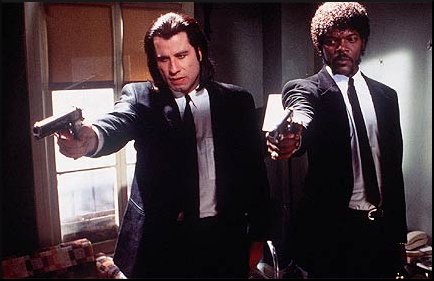
There is many male protagonists however who are not represented in a stereotypical "Hero" way however, this is common in thriller films as they are often involved in criminal activity,an example of this is the cast from "Reservoir Dogs" who are involved in a diamond hiest.Some characters kill innocent civillians, one character goes as far as slashing  another man's ear off. This is far from a heroic act, it does make the man look tough and voilent, but he in actual fact looks like the villain of the film.


There is many male protagonists however who are not represented in a stereotypical "Hero" way however, this is common in thriller films as they are often involved in criminal activity,an example of this is the cast from "Reservoir Dogs" who are involved in a diamond hiest.Some characters kill innocent civillians, one character goes as far as slashing  another man's ear off. This is far from a heroic act, it does make the man look tough and voilent, but he in actual fact looks like the villain of the film.

Women in Thriller films are often represented as being very feminine, physically weak and powerless, mentally emotional and fragile. An example of a woman in a thriller film who has some of these characteristics is Aridrane from "Inception" she is one of the main characters in the film and although she is mentally strong and very intellegent, she uses he brains to solve all of her problems opposed to using her physical side.

There are many females in Thriller films who totally go against this stereotype however, Foster from "Silence of The Lambs" is a classic example of this, she is in the FBI and gets in gunfights, she is both the protagonist and the "Hero" of the film.    

Different Ethnic Groups:

Ethnic groups are represented in different ways in thriller films, generally these are stereotypical views which are often used within the film industry. Some of the characteristics which white people often have in thriller films is that they are intellegent, dominant, in- control, good and innocent. They are often seen as the "heroes"  and saviours of the film. An example of this from a thriller film, is Batman from "The Dark Knight".
Other ethnicities are often represented as weaker, powerless, the victims, criminals and subservient.
Denzel Washington plays a dangerous criminal in the film "Safe House", and the CIA agent finds it hard to keep control of him.
Ethnicities are sometimes seen to clash with one an other, and may not always get along, a thriller film which strongly shows this is "Crash (2004)", a film set in Los Angeles, there is a white police officer who is racist towards his African-American detective partner and a hispanic male. Throughout the film there is a lot of racial tension between all of the different ethnicities.


Different Classes

In Thriller films, class isn't shown to effect the outcome as much as it does in other films. The upper class people do seem to have power and control, especially in Crime/thriller films where they will show their wealth by wearing expensive clothes such as suits and be smoking cigars, like the film Resevoir Dogs when characters are always walking around in suits, this gives you the impression that they are of a higher class and status opposed to ordinary people.

Working class people are often underrepresented in Thriller films, which often leads them to turn to criminal activity to make a living. Generally in thriller films class is not easily identifyable with some characters, so the audience assume that they are working/ middle class if they are just leading was seems to be an ordinary lifestyle.

Different Ages:

Thriller films generally tend have generally adults around the age of 20-50 as the protagonists and main characters, this is seen as the conventional age for characters in thriller films as this generally is the age group as to where people are most capable in many aspects of life (physically and mentally). famous examples of characters from this age group are shown below.Adults are often represented as clever, hard working and the saviours


Children are often represented as sweet and innocent, but they are often seen as very vunerable, like John Connor from "The Terminator 2", he needs to always be with the Terminator at all times ultimately to prevent being killed or captured.    


The elderly are represented as weak and fragile, and less capable. They can be seen as role models and leaders however, such as Joe Cabot from "Resevoir Dogs", he is the leader of the criminal gang, and the others do as he says


Equipment List

A list of technical equipment which we will need for our production, and post production is a crucial part in actually enabling us to film the opening sequence. Below is the list of equipment which is vital for us.

Digital Video Camera:
  •  This will be needed to record our footage, and is perhaps the most important piece of equipment needed to complete or even start an opening sequence.


Tripod:
  •  This will be used so we are able to place our camera on a steady surface when filming the first location of our sequence.  


Radio:
  • We will need an old radio player, but although this will be featured in our opening sequence the music playing doesn’t need to come play from it, therefore a radio playing music off the scene will be just as effective.  
  • This is a vital piece of equipment which we need. Once the filming has been completed we will then use the Macs to edit the footage. The two main software’s we will be using is ‘Final Cut Express’ and ‘Live Type’.


Audio Recorder:
  • This will be used so we can hear more clearly the girl trying to scream whilst her mouth is taped shut.


Lighting:
  •  A candle light will be used both in the first and second location, although we will have a small amount of lighting in the background this will be the prevailing light used. This is because of the flickering effect a candle has on the characters face.